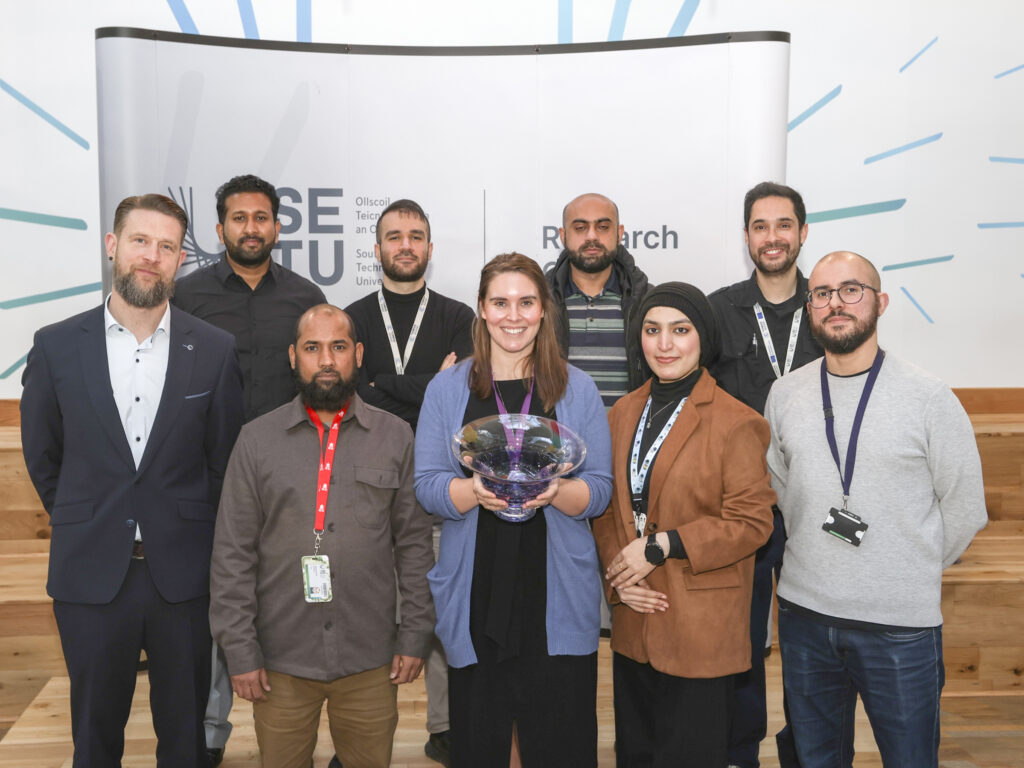



OcuHealth, an emerging eye therapeutics start-up led by South East Technological University (SETU) in collaboration with University College Dublin (UCD), has been announced as the overall winner of this year’s VentureLaunch Accelerator Programme.
The award recognises the significant commercial potential of OcuHealth’s breakthrough approach to treating eye disease and marks an important milestone for the collaborative research partnership between SETU and UCD.
Substantial improvement on current treatments
OcuHealth is developing a novel “once-a-day” eye drop that offers slow, sustained drug delivery to all parts of the eye. This represents a substantial improvement on current treatments, many of which must be administered multiple times daily due to rapid wash-off of conventional eye drop formulations. The company’s platform can deliver a wide range of therapeutic molecules and has the potential to transform treatment for multiple eye diseases. Its first target is dry eye disease, a highly prevalent condition with symptoms that affect work, sleep, mental health and daily quality of life.
Eye drops remain the preferred mode of ocular drug delivery. However, traditional drops typically achieve limited absorption (often as little as 1-5%) because blinking and tearing rapidly remove them from the surface of the eye. This leads to more frequent dosing and higher concentrations of drug to achieve a therapeutic effect.
The technology emerging from this partnership has the potential to change how we treat common and often debilitating eye conditions.”
Dr Laurence Fitzhenry, Ocuhealth project lead, and SETU Head of School of Science and Computing
Greater delivery of drugs to the patient
To address this challenge, OcuHealth has developed a number of patented nanotechnologies. OcuHealth’s approach allows greater delivery of both hydrophilic and hydrophobic drugs, including monoclonal antibodies, over an extended period. The formulation is based on lipids similar to the healthy fats that naturally protect the surface of cells and has the added advantage of supporting tear-film health.
A meaningful reduction in disease-related inflammation
As proof of concept, OcuHealth’s researchers combined their lipid nanoparticles with an existing steroid drug to explore its potential for treating dry eye disease. Preclinical findings show that a single drop targets the eye effectively, is rapidly absorbed and releases the drug over 24 hours to the front of the eye. The drug remains within the eye rather than entering the circulatory system, and biomarker analysis indicates a meaningful reduction in disease-related inflammation. These results compare favourably with existing competitor products.

Collaborative effort
The project has secured €700,000 in Enterprise Ireland Commercialisation Fund support and is jointly advanced by SETU’s Technology Transfer Office and UCD’s NovaUCD. The collaboration illustrates SETU’s growing impact in advanced therapeutics and health-related research, reinforcing the university’s role in supporting commercially focused innovation within the region and beyond.
Speaking about the recognition for OcuHealth, Dr Laurence Fitzhenry highlighted the value of the joint research effort, “Our work with UCD demonstrates the strength of collaboration in addressing significant health challenges. The technology emerging from this partnership has the potential to change how we treat common and often debilitating eye conditions. SETU is proud to contribute scientific leadership, combined with drug delivery and translational expertise to bring this innovation closer to patients.”
OcuHealth is a strong example of how SETU supports research teams to translate excellent science into investable start-up opportunities.”
Dr James O’ Sullivan, SETU Head of Innovation and Commercialisation
Dr James O Sullivan of SETU’s Technology Transfer Office underlined the importance of commercialisation support in initiatives such as OcuHealth.
He explained, “Our team has worked closely with the OcuHealth researchers to shape the commercial pathway for this technology, from protecting the underlying intellectual property through to securing Enterprise Ireland funding and collaborating with NovaUCD. OcuHealth is a strong example of how SETU supports research teams to translate excellent science into investable start-up opportunities with the potential for real health impact.”
The multidisciplinary OcuHealth team includes Dr Alison Reynolds, Assistant Professor at the UCD School of Veterinary Medicine and fellow of the UCD Conway Institute, who completed and won the VentureLaunch Programme. Dr Reynolds was instrumental in securing funding of 25,000 euros for the Ocuhealth spin-out. At SETU, the team is led by Dr Laurence Fitzhenry, Head of Faculty of Science and Computing (Waterford) and Principal Investigator of the Ocular Therapeutics Research Group at SETU; with the project team comprising Dr Muhammad Sarfraz, Department of Science, SETU; and commercial lead John Lynch, Professor Peter McLoughlin, former SETU Head of Science and Computing, Dr Orla O’ Donovan, SETU Head of Department of Science, Dr Niall O’ Reilly, PMBRC Centre Manager, Dr Sweta Rani, SETU Lecturer in Department of Science.
OcuHealth now plans to continue its development and commercialisation pathway, supported by both universities as it progresses toward clinical validation and market readiness.